

The Mindbloom Method is clinically validated across the 3 largest peer-reviewed studies of ketamine therapy ever published.
All three showed stellar outcomes across anxiety, depression, PTSD, and more.








Mindbloom’s research archive




At-home, telehealth-supported ketamine therapy for veterans with depression, anxiety, and PTSD: Findings from a real-world, observational study



Mindbloom is committed to advancing psychedelic science, with the largest body of research of any ketamine therapy provider following more than 11,000 clients.
Symptom improvement
reported symptom improvement in anxiety & depression1
reported meaningful PTSD symptom improvement2
with suicidal thoughts reported them fully resolved within program completion1

Speed to results
Not only does our at-home ketamine program greatly reduce feelings of anxiety and depression, it does so in hours or days—not months.
Mindbloom1
Hours to days
Tradtional SSRIs3
4-8 weeks

With traditional treatments, people might not notice improvements for up to 2 months—that is, if they see improvements at all. Because of ketamine’s fast-acting nature, most Mindbloom clients report symptom relief after just 4 sessions, and some after their very first session.
Side effects
experienced no side effects with Mindbloom treatment1

Many come to Mindbloom frustrated by side effects of their SSRIs (weight gain, emotional flatness, loss of libido). Our peer-reviewed studies demonstrate the high tolerability profile of this treatment. The mild effects that may occur typically clear within hours. That's why people finish their programs, and why Mindbloom’s care model actually works.
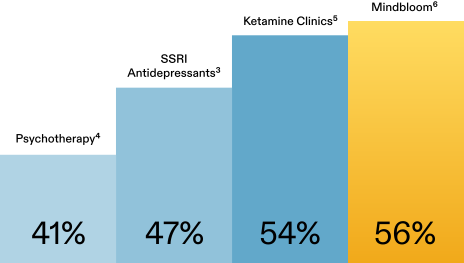
Treatment comparisons
When compared to studies of alternative treatments, Mindbloom’s symptom improvements were stronger and achieved in just 4 weeks vs 2+ months.

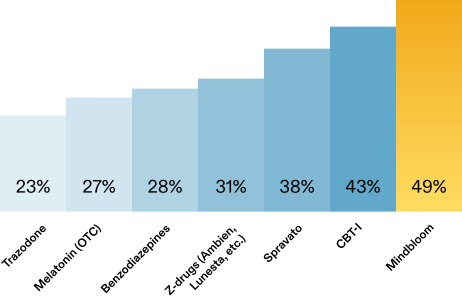
Sleep
The largest ketamine sleep analysis to date saw clients report significant improvement—better than Ambien, trazodone, melatonin, and CBT for insomnia—often visible after just 2 Mindbloom sessions.7
saw clinically meaningful improvement in sleep

Veterans
The largest evaluation of ketamine therapy in veterans ever published saw tremendous outcomes across anxiety, depression, and PTSD.8
Ketamine has been used safely and effectively for mental health for 20+ years.
With over 300 major studies conducted across 50+ institutions, clinical research continues to demonstrate that ketamine can be successfully used to treat mental health conditions and their symptoms.
At-Home Telehealth-Supported Subcutaneous Ketamine Therapy in Adults With Moderate to Severe Depression, Anxiety, or PTSD: A Real-World Observational Study of Safety, Feasibility, and Clinical Outcomes in a Large, Heterogeneous Cohort in the United States
This real-world retrospective analysis evaluated 3,041 adults across 38 states treated with subcutaneous (injectable) ketamine through Mindbloom's guided at-home program, the first peer-reviewed outcomes for the subcutaneous route. After a six-session course, at least 80% of patients in every condition saw clinically meaningful improvement, with response rates of 76.7% for PTSD, 60.6% for anxiety, and 56.6% for depression, alongside an infrequent, generally mild side effect profile.
Burnout Symptom Outcomes During At-Home Ketamine-Assisted Therapy: A Real-World Retrospective Analysis of 395 Adults
This real-world retrospective analysis evaluated at-home ketamine-assisted therapy in 395 adults with elevated occupational burnout symptoms measured by the Maslach Burnout Inventory-General Survey. After six guided sessions over approximately 4–6 weeks, 69.6% improved on at least one burnout subscale, with mean reductions of 27% in exhaustion and 22% in cynicism, while side effects remained low and no serious side effects were reported.
Prolonged Grief Symptom Outcomes During At-Home Ketamine-Assisted Therapy: A Real-World Retrospective Analysis of 503 Adults
This real-world retrospective analysis evaluated at-home ketamine-assisted therapy in 503 adults with clinically elevated prolonged grief symptoms. After six guided sessions, 76% of completers achieved a meaningful PGD-13 improvement and 64% dropped below the score-based severity threshold, with side effects uncommon.
Real-world sleep outcomes following guided at-home ketamine therapy in a large clinical cohort
This retrospective analysis evaluated sleep outcomes among nearly 14,000 adults who participated in Mindbloom’s guided at-home ketamine therapy program. Results demonstrated high rates of clinically meaningful sleep improvement, substantial reductions in sleep disturbance severity, and a strong tolerability profile with outcomes comparing favorably to those reported for many conventional sleep treatments.
You deserve proof, not promises.

Hull TD, et al. Journal of Affective Disorders (2022). https://doi.org/10.1016/j.jad.2022.07.004.
Parks AC, et al. Journal of Medical Internet Research (2026). https://doi.org/10.2196/92647.
Trivedi M,. et al. American Journal of Psychiatry (2006). https://doi.org/10.1176/appi.ajp.163.1.28.
Cuijpers P, et al. Acta Psychiatrica Scandinavica (2021). https://doi.org/10.1111/acps.13335.
McInnes L. A., et al. Journal of Affective Disorders (2022). https://doi.org/10.1016/j.jad.2021.12.097.
Mathai DS, et al. Journal of Affective Disorders (2024). https://doi.org/10.1016/j.jad.2024.05.131
Swain et al., Research Square (2026). https://doi.org/10.21203/rs.3.rs-9553669/v1.
Lutz et al., Manuscript in preparation (2026)

